
In the fields of modern metal processing and equipment manufacturing, centrifugal casting has become the ideal choice for producing high-performance products such as roll rings and sleeves due to its unique physical properties. By utilizing centrifugal force, this process offers significant advantages in enhancing overall product performance, reducing costs, and meeting complex production requirements.

I. Optimizing Product Quality and Achieving a High-Density Microstructure
The core advantage of centrifugal casting lies in its ability to significantly optimize a product’s internal quality. During the casting process, molten metal fills the mold and solidifies under the influence of centrifugal force. This process facilitates the removal of gases and inclusions from the molten metal, thereby effectively reducing common casting defects such as porosity and slag inclusions. Furthermore, centrifugal force promotes the formation of a more uniform microstructure during solidification, which not only ensures consistent product quality but also significantly enhances the product’s reliability during actual use.
II. Improving Cost-Effectiveness and Achieving Cost Reduction and Efficiency Gains
In terms of manufacturing economics, the centrifugal casting process offers distinct competitive advantages:
Reduced Metal Consumption: This process requires virtually no pouring or riser systems. Compared to traditional casting methods, it significantly reduces metal consumption, directly lowering production costs.
Reduced Machining Allowances: Centrifugal casting produces roller rings and sleeves with high dimensional accuracy and excellent surface quality. In fields with relatively lenient precision requirements, such as mining and construction machinery, this allows for minimal or no machining, further optimizing the production process.

III. Simplified Process Flow and Significantly Improved Production Efficiency
Centrifugal casting demonstrates exceptional flexibility in the production of hollow roller rings and sleeves. Since no cores are required, the production process is greatly simplified, shortening production cycles and reducing manufacturing costs. At the same time, centrifugal force helps molten metal fill the mold cavity more effectively, ensuring complete formation even for complex-shaped or thin-walled ring and sleeve products, thereby enhancing production flexibility and overall efficiency.
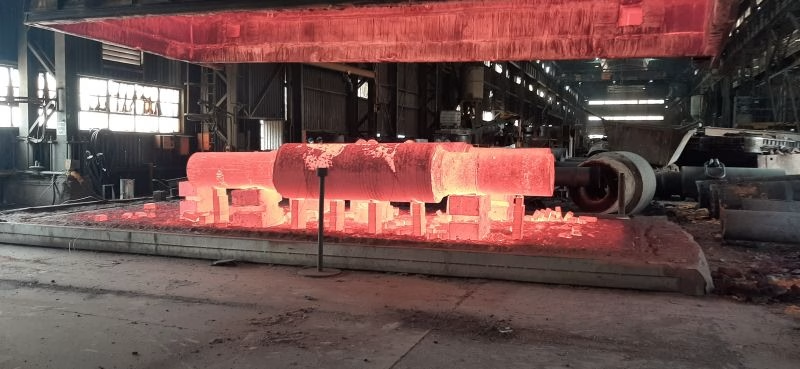
IV. Meeting Special Customer Requirements and Addressing the Challenges of Large Castings
Centrifugal casting demonstrates exceptional adaptability for the production of extra-tall, extra-heavy, large-sized roller rings and sleeves. Traditional casting methods often result in defects such as porosity and cracks when producing such large castings, whereas centrifugal casting effectively avoids these issues. This better guarantees product performance and quality, precisely meeting the market’s specific demands for large-scale roller rings and sleeves.
Summary
In summary, the centrifugal casting process is not only a technical solution to the challenges of manufacturing complex industrial components but also a modern manufacturing method that creates core value for manufacturing enterprises by improving product quality, shortening production cycles, and optimizing cost structures.