
In many steel mills around the world, roughing mill work rolls used in hot rolling mills suffer from bonding zone contact fatigue damage before reaching the scrap diameter. This issue arises due to various factors such as rolling high-resistance steel grades, longer rolling campaigns, fewer passes with heavier reductions to boost mill output, and insufficient maintenance of support or work rolls.
Numerical Tools for Roll Geometry Optimization
To help optimize the use of hot mill rolls, a numerical tool has been developed to refine the geometry of roughing mill rolls. These optimized steel mill rolls aim to better resist fatigue and extend service life under demanding rolling conditions.
Historical Development of Roll Materials
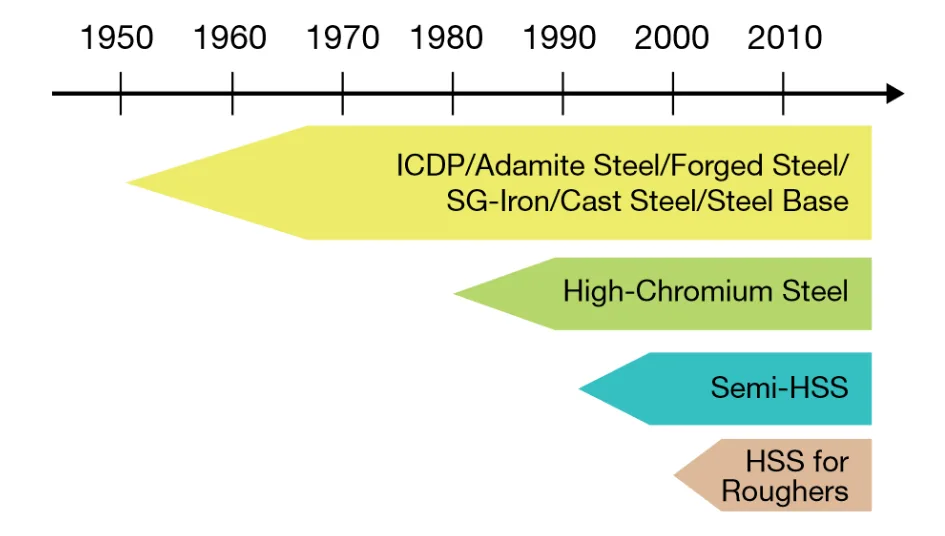
High chromium steel was introduced in Europe in the early 1980s to replace underperforming materials such as semi-steel rolls, centrifugal cast indefinite chilled cast iron (ICDP), and forged rolls. Since then, this roll type has been widely adopted in roughing stands of existing hot strip mills and early continuous thin slab rolling finishing mills.
Rising Performance Demands and the Rise of Semi-HSS Rolls
Rolling mills needed higher output, better quality, and more safety. These growing demands increased pressure on roll performance and cost. In response, roll manufacturers developed a new generation of roughing mill rolls in the early 1990s. This resulted in the development of semi-high-speed steel (semi-HSS) rolls, which gained rapid adoption, especially in Western Europe. However, some applications, such as stainless and special steel rolling, require further material improvements.
Emergence of High-Speed Steel (HSS) Rolls
By the late 1990s, special high-speed steel (HSS) rolls were developed for roughing mill use to meet these new challenges. The evolution of hot mill rolls is illustrated in charts tracking the history of work roll development for plate and strip mills.
Impact of Semi-HSS Rolls on Mill Performance
Semi-HSS rolls significantly extended roughing mill roll life and enabled five-pass reductions, boosting reversing roughing mill output.This was possible thanks to the semi-HSS rolls’ superior biting performance.
Comparison of Production Volumes by Roll Type
In the late 1980s, high chromium steel rolls in semi-continuous mills achieved campaign rolling quantities of 20,000 to 40,000 tons. Fully continuous mills could reach 80,000 to 100,000 tons. Today, semi-continuous mills using semi-HSS rolls roll between 65,000 and 120,000 tons per campaign, while fully continuous mills can exceed 200,000 tons. Clearly, modern steel mill rollers now endure two to three times more output per campaign compared to past decades.
European Mill Roll Use and Fatigue Issues
A reference table summarizes the current status of hot rolling mill rolls used in European strip mills, showing roll types, steel grades, standard rolling campaign volumes, and fatigue issue occurrences. It includes data for both carbon and stainless steel rolling mills, excluding plate and Steckel mills.
Configuration and Fatigue Trends in European Mills
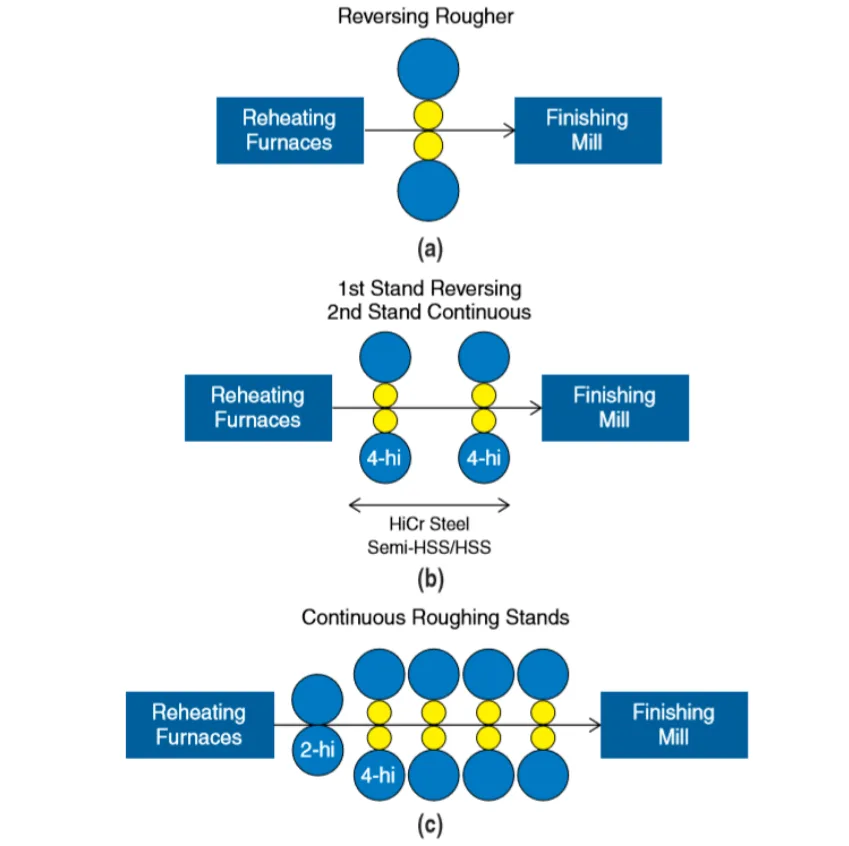
Engineers illustrate three common European roughing mill configurations, each with unique designs and rolling conditions.Despite increased rolling loads and reduced pass schedules (from 7 to 5 passes), core materials and bonding interface properties of these mill rolls remain largely unchanged. The resulting stress leads to more frequent fatigue phenomena.
Prevalence and Impact of Bonding Zone Fatigue
These failures—especially bonding zone fatigue—are more prevalent in semi-continuous or 3/4 layout mills. So far, fully continuous rolling mills have not reported such problems. Of the 15 reversible roughing mills surveyed in Europe, 8 face fatigue issues, and the number is rising. This trend poses a critical concern for both steel producers and roll suppliers.
Standard Industry Response: Increased Discard Diameter
A standard countermeasure now includes increasing the discard diameter of roughing mill rolls, allowing for a thicker work layer (25 mm or more) to prevent bonding zone fatigue. While this solution temporarily addresses the issue, long-term improvements in roll forging techniques, roll geometry, and material advancement remain vital.

Conclusion: Future Directions in Mill Roll Optimization
Optimizing steel mill rolls is essential. Use numerical simulation to improve design. Choose better materials like semi-HSS and HSS. Strengthen maintenance practices. These steps meet hot rolling demands. The same applies to cold rolling mill rolls. Forged and roll-forged products also benefit. Roll technology continues to advance. Modern steel mills gain better performance, safety, and efficiency.
Contact us: cykc@cykcgroup.com.cn